

We recently hosted a Lunch & Learn on “Crowding in Water Technology Capital for the Colorado River” in New York City with Professor Upmanu Lall of Arizona State University.
The event featured Professor Lall’s perspective on addressing the region’s growing water challenges, an overview of KMX’s proprietary decentralized and scalable water recovery technology presented by Dr. Sean Ghayeni, KMX’s Head of Technology, and examples of how KMX is working alongside customers across multiple end-markets throughout the region.
The Lunch & Learn also included conversations with attendees on the intersection of water technology, policy, and markets.
The event follows recent meetings we had with Congressional leaders spanning the Colorado River Basin.
In this update, I’ll provide key takeaways from the KMX Lunch & Learn, including:
- Prof. Lall’s Framework for Water Affordability in the Basin
- Decentralized Scalable Water Technology Solutions
- How KMX is Supporting End-Markets to Maximize Water Recovery
Willingness to Pay for Water in the Colorado River Basin
As highlighted in my recent article, “How New Industries Can Crowd in Water Technology Capital for the Colorado River Basin”, new demand for freshwater from data centers, chip fabrication plants, and critical mineral projects in the already arid American West, Southwest, and Texas, is being met with significant local community concerns.
At the same time, growth from these industries presents an opportunity to attract capital toward next-generation water technologies in and around the Colorado River Basin, helping address decades of water stress, overallocation, and infrastructure underinvestment.
Prof. Lall highlighted how companies in various high-margin and well capitalized end-markets, including semiconductors, data centers, and mining (hard-rock and brine) have a “willingness to pay” (WTP) in the $1,000s per acre foot (AF), representing a 5x premium to agriculture (the dominant water user in the basin), as shown in the right-side column in Figure 1 below.
Prof. Lall also highlighted how population growth across the region is driving increased electricity demand, strengthening the capacity of power and utility companies to invest in water infrastructure and water security solutions.
Figure 1: Willingness to Pay (WTP) per Acre Foot ($/AF) for Water by Industry in the Colorado River Basin

Source: Lall, U, 2026; Ceres, 2025
Decentralized Scalable Water Technology Solutions
Addressing the water challenges facing the American West will require a decentralized and scalable portfolio of solutions deployed across multiple end-markets.
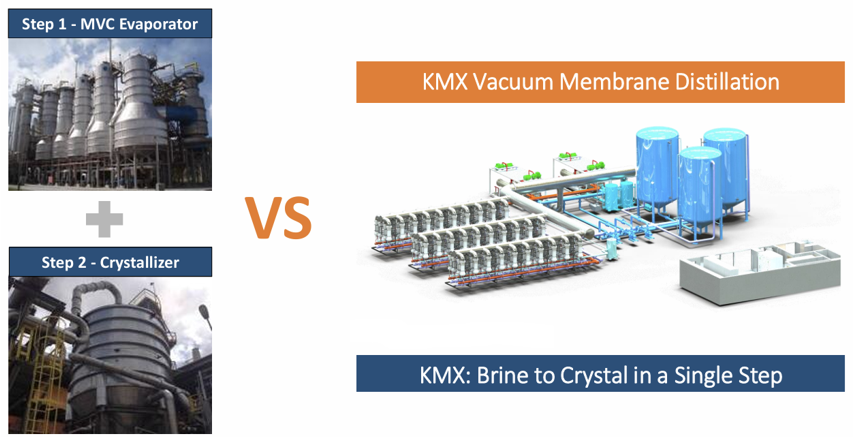
KMX’s VMD technology is designed to maximize water recovery from challenging industrial streams while reducing reliance on energy-intensive thermal concentration technologies such as mechanical evaporators and crystallizers.
In addition to delivering significant cost savings, KMX’s VMD enables companies to deploy small-scale brine concentration systems without the high fixed costs associated with conventional evaporators, which are often uneconomic at smaller scales.
This concept came as a surprise to some Lunch & Learn attendees, prompting discussion around the comparative economics and CAPEX requirements of KMX systems relative to traditional evaporators and crystallizers, which often struggle to scale down efficiently.
Figure 2: KMX VMD vs. Mechanical Evaporators and Crystallizers
Source: KMX Technologies, Veolia
KMX’s VMD technology is powered by our proprietary membrane bundle that operates at a lower temperature than competing processes and enables the recovery of high purity water and any minerals that could be of value, as shown in Figure 3.
Figure 3: How KMX’s VMD Maximizes Water and Mineral Recovery

Source: KMX Technologies
How KMX is Supporting End-Markets to Maximize Water Recovery
In the arid American West and Southwest, KMX is bringing our scalable and decentralized solution to several end-markets to maximize water and mineral recovery, including oil & gas produced water desalination, critical minerals, food & beverage, and data centers.
During the Lunch & Learn, we discussed how KMX is helping customers reduce wastewater discharge, improve operating economics, and strengthen water security across the regions in which they operate.
Further, we were also excited to share some preliminary findings from our ongoing pilot with a globally recognized beverage company.
For more on what KMX is doing in these end markets, see our recently published Quarterly Update here, which highlights the four commercial catalysts ahead for KMX.
Up Next
We look forward to continuing the conversation through future Lunch & Learns, industry workshops, and other initiatives focused on accelerating investment in water infrastructure and water technology solutions.
We look forward to sharing more details soon.
To join for future KMX Lunch & Learns, sign up for our newsletter at Contact Us | KMX Technologies
Thank you for your continued support!
– Zac
Zachary Sadow

Chairman & CEO
KMX Technologies